"The Wall Street Journal reported today that the recession, plunging travel demand, and a tough lending environment are battering U.S. airlines, raising the prospect of a liquidity squeeze that could lead to bankruptcy filings by winter if conditions don't improve. The five largest carriers are expected to report second-quarter losses."
"Some carriers may have no choice but to seek protection from creditors this winter, or as early as this fall, when cash flow typically dries up. United, American and US Airways are the most vulnerable among large carriers, according to credit-rating agencies and Wall Street investment houses." (Start using up your frequent flier miles now before it is too late!)
Monday, July 13, 2009


Sunday, July 12, 2009

Brilliant Political Strategy or What?
We are being told that only 10% of the original $787 billion stimuli plan has been expended. The remaining 90% will finally get into the economy during the next one to two years. With unemployment at 9.5% (U6 rate of unemployment is already 16.5%, which is the true rate of the unemployment percentage.), which equates to something like 15 million people out of work, there is clamor by some on the Hill for another stimuli package. http://www.bls.gov/news.release/empsit.t12.htm
I, for one, consider that the Obama team really believes the eventual time horizon for that remaining 90% is a brilliant political move on their part. Why else would they delay 90% of the expenditures until next year? My reasoning will follow shortly.
No one can doubt his overall popularity and what it has gotten him so far. For instance, in his first six months, he has been able to nationalized specific segments of the financial industry and, of course, the auto industry. Now, he wants to nationalized our health-care system and has introduce the largest indirect tax on the American people through the “Cap and Trade” bill, which has been passed by the House and currently being debated in the Senate. Now, popularity only goes so far in Washington, D.C., as witnessed by the fact that more people currently disagree with his handling of the economy than approve of his handling of it.
Now, because of his popularity and the Democratic controlled Congress, President Obama will probably get his social agenda passed in one form or another. However, in doing so, he will have used up most of his political capital this year. I believe that the electorate will become increasing disenchanted with President Obama as the unemployment rate heads above 10%. Remember President Clinton saying during his campaign for the presidency that "it is about the economy." Obama knows that, and he knows that so very well. But again, when will that 90% of the $787 billion get into the economy? Of course, that 90% will start stimulating the economy in 2010. And, what happens in 2010? The mid-term Congressional elections will occur. Obama believes that the 90% will be more than sufficient to not only stimulate the economy out of the recession, for which he and the Democrats get the credit, but to assist in electing Democrats back to Congress next year. This time lag, stimuli strategy is brilliant. However, if the economy does not improve next year, and the Democrats lose seats in the upcoming mid-term election; President Obama can still push through a “second” stimulus plan to assist him in his 2012 reelection campaign. Time will tell if this is a brilliant strategy after all or not.
Saying all that, I don’t believe the stimuli will grow the economy in real terms. I firmly believe that we cannot spend our way out of this economic malaise in a time when the American people are deleveraging themselves from debt. It has not worked in the past, and it will not work now. Real economic growth occurs through real investments/savings, not by government spending through monetarization.
I, for one, consider that the Obama team really believes the eventual time horizon for that remaining 90% is a brilliant political move on their part. Why else would they delay 90% of the expenditures until next year? My reasoning will follow shortly.
No one can doubt his overall popularity and what it has gotten him so far. For instance, in his first six months, he has been able to nationalized specific segments of the financial industry and, of course, the auto industry. Now, he wants to nationalized our health-care system and has introduce the largest indirect tax on the American people through the “Cap and Trade” bill, which has been passed by the House and currently being debated in the Senate. Now, popularity only goes so far in Washington, D.C., as witnessed by the fact that more people currently disagree with his handling of the economy than approve of his handling of it.
Now, because of his popularity and the Democratic controlled Congress, President Obama will probably get his social agenda passed in one form or another. However, in doing so, he will have used up most of his political capital this year. I believe that the electorate will become increasing disenchanted with President Obama as the unemployment rate heads above 10%. Remember President Clinton saying during his campaign for the presidency that "it is about the economy." Obama knows that, and he knows that so very well. But again, when will that 90% of the $787 billion get into the economy? Of course, that 90% will start stimulating the economy in 2010. And, what happens in 2010? The mid-term Congressional elections will occur. Obama believes that the 90% will be more than sufficient to not only stimulate the economy out of the recession, for which he and the Democrats get the credit, but to assist in electing Democrats back to Congress next year. This time lag, stimuli strategy is brilliant. However, if the economy does not improve next year, and the Democrats lose seats in the upcoming mid-term election; President Obama can still push through a “second” stimulus plan to assist him in his 2012 reelection campaign. Time will tell if this is a brilliant strategy after all or not.
Saying all that, I don’t believe the stimuli will grow the economy in real terms. I firmly believe that we cannot spend our way out of this economic malaise in a time when the American people are deleveraging themselves from debt. It has not worked in the past, and it will not work now. Real economic growth occurs through real investments/savings, not by government spending through monetarization.
Saturday, July 11, 2009
Stashing Cash in Banks: Is it Really Safe?
The FDIC has a calculator on its site called EDIE, or Electronic Deposit Insurance Estimator, to help determine whether you are fully covered at your bank. You can determine if you are covered by clicking on EDIE and going through a few calculations.
The standard insurance amount currently is $250,000 per depositor. The $250,000 limit is
permanent for certain retirement accounts, which includes IRAs. The $250,000 limit is temporary for all other deposit accounts through December 31, 2013. On January 1, 2014, the standard insurance amount will return to $100,000 per depositor for all account categories except certain retirement accounts, which will remain at $250,000 per depositor. However, structure your holdings correctly and, as an individual, you can obtain more than $1 million in coverage per bank. A couple can get about $2 million in coverage per bank. Click-on "FDIC Coverage" for a synopsis.
The standard insurance amount currently is $250,000 per depositor. The $250,000 limit is
permanent for certain retirement accounts, which includes IRAs. The $250,000 limit is temporary for all other deposit accounts through December 31, 2013. On January 1, 2014, the standard insurance amount will return to $100,000 per depositor for all account categories except certain retirement accounts, which will remain at $250,000 per depositor. However, structure your holdings correctly and, as an individual, you can obtain more than $1 million in coverage per bank. A couple can get about $2 million in coverage per bank. Click-on "FDIC Coverage" for a synopsis.
Friday, July 10, 2009
DXO: Ultra-long Oil
$3.50 still remains the critical price mass for DXO. Technically speaking, the price could decline to $3.40 and still remain bullish. Anything less than $3.40 would generate a "High-Pole Formation," which would render a bearish scenario. (See comments within chart.) Note: To enlarge the chart, double-click inside of it.
 Note: To enlarge the chart, double-click inside of it.
Tuesday, July 07, 2009
Today's Comments
Comments for today, July 7, can be read at Twitter. Currently, I am looking for some near term market relieve to eliminate some of the oversold conditions as seen on the hourly charts. S&P 500 is poised to drop to the 800 level.
Sunday, July 05, 2009

Saturday, July 04, 2009

Friday, July 03, 2009
Bollinger Bands
Developed by John Bollinger, Bollinger Bands are an indicator that allows users to compare volatility and relative price levels over a period time. The indicator consists of three bands designed to encompass the majority of a security's price action.
1. A simple moving average in the middle
2. An upper band [SMA plus 2 standard deviations (SD)]
3. A lower band [SMA minus 2 standard deviations (SD)]
For general time frames, Bollinger recommends a 10-day simple moving average (SMA) for the short term, a 20-day simple moving average (SMA) for the intermediate term and 50-day simple moving average for the long term.
BigCharts use a 20-day SMA but does not display the SMA in the chart. It incorporates the upper band (2 SD above SMA) and lower band (2 SD below the SMA). Notice how well the Bollinger Bands contained the weekly closing prices of the S&P 500 over the past ten years, especially the price activity over the past several weeks! See the following chart. Note: To enlarge chart, double-click inside of it.
It should be noted that Bollinger did not use this indicator to generate buy and sell signals when prices reach the upper or lower bands. Such levels merely indicate that prices are high or low on a relative basis. A security can become overbought or oversold for an extended period of time. However, knowing whether or not prices are high or low on a relative basis should assist and enhance one’s buying and/or selling decisions.
Source: StockCharts.Com
1. A simple moving average in the middle
2. An upper band [SMA plus 2 standard deviations (SD)]
3. A lower band [SMA minus 2 standard deviations (SD)]
For general time frames, Bollinger recommends a 10-day simple moving average (SMA) for the short term, a 20-day simple moving average (SMA) for the intermediate term and 50-day simple moving average for the long term.
BigCharts use a 20-day SMA but does not display the SMA in the chart. It incorporates the upper band (2 SD above SMA) and lower band (2 SD below the SMA). Notice how well the Bollinger Bands contained the weekly closing prices of the S&P 500 over the past ten years, especially the price activity over the past several weeks! See the following chart.
 Note: To enlarge chart, double-click inside of it.
It should be noted that Bollinger did not use this indicator to generate buy and sell signals when prices reach the upper or lower bands. Such levels merely indicate that prices are high or low on a relative basis. A security can become overbought or oversold for an extended period of time. However, knowing whether or not prices are high or low on a relative basis should assist and enhance one’s buying and/or selling decisions.
Source: StockCharts.Com
S&P 500 Update for the Week Ending July 2, 2009
The S&P 500 was repelled at the “declining” 40-Week EMA and is now right on support (896), which is the rising 15-Week EMA. See the following chart. [In order to give a valid “buy signal,” the 15-week EMA must be rising when it penetrates the 40-Week EMA, which also must be rising.] Also, the relative strength chart (RSI) has now turned down from slightly above 50 to slightly below it. In bull markets, RSI remains consistently above 50, and in bear markets, RSI remains consistently below 50. See the following chart.
Therefore, the critical price is 896. A weekly close below this level would probably foreshadow a decline to 800-850. Note: To enlarge the chart, double-click inside of it.
Therefore, the critical price is 896. A weekly close below this level would probably foreshadow a decline to 800-850.
 Note: To enlarge the chart, double-click inside of it.
Monday, June 29, 2009

TSY and Agency Securites: Who is Buying?
The following two charts, curiosity of Contrary Investor, depicts the overall trend of foreign purchases of Treasury and Agency securities. My comments are provided within each chart.
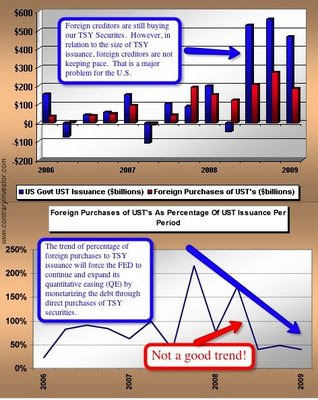

I firmly believe that "Quantitative Easing (QE) through debt monetarization will not only continue but will be expanded. QE is a main reason why I have become more bullish to gold (GLD) and silver (SLV). GLD and SLV, based on technical analysis, are both looking very attractive. Stay tuned!


I firmly believe that "Quantitative Easing (QE) through debt monetarization will not only continue but will be expanded. QE is a main reason why I have become more bullish to gold (GLD) and silver (SLV). GLD and SLV, based on technical analysis, are both looking very attractive. Stay tuned!
Sunday, June 28, 2009
Weekly Update on S&P 500: 15- and 40-Week EMAs
 Note: To enlarge the chart, double-click inside of it.
I will be watching UGL and AGQ very closely this week for potential buy signals. Alignment between and among PPO, Stochastics, and CCI are just about in place for those 200% leverage ETFs. I still have a position DTO. I will be updating on Twitter. Therefore, if you want to follow my inter-day market updates on ETFs and ETNs that I am following, go to Twitter.Com/DeBauche.
Thursday, June 25, 2009
UGL (Ultra-Gold): 200% Leverage
I mentioned on Twitter today that gold and silver are starting to "look" attractive. The only part of the puzzle that is not in alignment is PPO. Full Stochastics and Community Channel Index (CCI) are already "flashing" a buy signal. Let's wait until that final piece of the puzzle is in place before committing any financial resources. See the details about UGL in the following chart: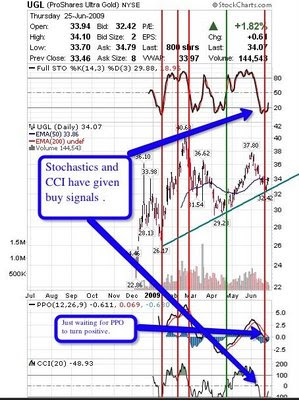 Note: To enlarge the chart, double-click inside of it.
 Note: To enlarge the chart, double-click inside of it.
Wall Street Journal: Climate Bill Biggest Tax in American History
The Wall Street Journal reports that the Cap and Trade would cost the economy $161 billion in 2020, which is $1,870 for a family of four. As the bill's restrictions kick in, that number rises to $6,800 for a family of four by 2035. For the full article, click-on Cap and Tax Fiction.
What a great way to grow the economy! Where is our sanity?
What a great way to grow the economy! Where is our sanity?
Wednesday, June 24, 2009
$100,000 of Your Tax Money to Breed Wyoming Toads
Once again, I am not that creative to make this stuff up. Read all about it at Grants.Gov.
Warren Buffett to CNBC: U.S. Economy In "Shambles"
"In a live interview on CNBC today, Warren Buffett said there has been little progress over the past few months in the "economic war" being fought by the country. "We haven't got the economy moving yet." While the economy is a "shambles" and likely to stay that way for some time, he remains optimistic there will eventually be a recovery over a period of years. Despite his negative view on the economy, Buffett still believes the stock market is attractive "over the next 10 years" when compared to alternatives like Treasury bonds." For the full interview, click-on CNBC.
Tuesday, June 23, 2009
Updates on Specific ETFs and ETNs
Tomorrow is FOMC day! I can not imagine much will happen until the magical time of 2:15 EST. The dollar is still crucial going forward for my bearish thoughts on oil. Today was not a good day for the dollar. As measured by UUP, it was down 1.18%. I still believe the dollar has a little more on the upside, which would correspond to oil moving into oversold territory as measured by PPO, Stochastics, RSI, and CCI. The same statement can be made for the metals, gold and silver.
The following comments are updates on those ETFs and ETNs that I am currently following or have positions:
GLD ($90.92) -- Support is right at its 200-day EMA of $88. If dollar strengths, GLD will sell off towards support at $88.
GLL ($15.34) -- It is right at support. It's 50-day EMA is at $15.44, which has been resistance. In addition, it has moved into overbought territory as measured by PPO, Stochastics, RSI, and CCI. I have a small position in GLL, which I may decide to liquidate tomorrow morning.
SLV ($13.63) -- Silver has support at $13.50. PPO, Stochastics, RSI, and CCI are moving into oversold territory. If it can hold the $13.50, I may be tempted to purchase it with a price object near term of $17, which is a major overhead resistance zone.
ZSL ($9.11) -- Support is at $9. However, PPO, Stochastics, RSI, and CCI are all over bought at the current price. Near term, I am negative.
DTO ($76.69) -- This double-inverse oil ETF has been my favorite trading vehicle recently. I liquidated this position on Monday at an average price of $79.01 for a 10.8% profit. Depending on the dollar, I could see DTO trading at $90. It is still on my radar.
UNG ($14.48) -- I have small position in UNG, which was part of my paired trade with DTO. DTO leg was lifted at a profit. However, I decided to hold UNG. It has been trading right at its 50-day EMA for the past week. I still like UNG, because I believe it is cheap in relation to oil (USO:UNG). That is the price spread will work in the favor of UNG.
The following comments are updates on those ETFs and ETNs that I am currently following or have positions:
GLD ($90.92) -- Support is right at its 200-day EMA of $88. If dollar strengths, GLD will sell off towards support at $88.
GLL ($15.34) -- It is right at support. It's 50-day EMA is at $15.44, which has been resistance. In addition, it has moved into overbought territory as measured by PPO, Stochastics, RSI, and CCI. I have a small position in GLL, which I may decide to liquidate tomorrow morning.
SLV ($13.63) -- Silver has support at $13.50. PPO, Stochastics, RSI, and CCI are moving into oversold territory. If it can hold the $13.50, I may be tempted to purchase it with a price object near term of $17, which is a major overhead resistance zone.
ZSL ($9.11) -- Support is at $9. However, PPO, Stochastics, RSI, and CCI are all over bought at the current price. Near term, I am negative.
DTO ($76.69) -- This double-inverse oil ETF has been my favorite trading vehicle recently. I liquidated this position on Monday at an average price of $79.01 for a 10.8% profit. Depending on the dollar, I could see DTO trading at $90. It is still on my radar.
UNG ($14.48) -- I have small position in UNG, which was part of my paired trade with DTO. DTO leg was lifted at a profit. However, I decided to hold UNG. It has been trading right at its 50-day EMA for the past week. I still like UNG, because I believe it is cheap in relation to oil (USO:UNG). That is the price spread will work in the favor of UNG.
Summers for Bernanke as Fed Chairman?
Rumor has it that Larry Summers will replace Ben Bernanke as Fed Chairman when his term is up in January. Summers is Obama's Director of the National Economic Council (NEC). Further, the rumor on Wall Street is that Summers agreed to be Obama's Director of the NEC as long as Obama appointed him as Fed Chairman in January 2010. I don't have a problem with replacing Bernanke but NOT with Summers. Now, lets work on a replacement for Tim Geithner as Treasury Secretary.
Monday, June 22, 2009
DTO (Double-short Oil)
Those of you that track my Twitter account knew that I sold my positions early this morning for an average price of $79.01, which equates out to a 10.8% return.
It had a gap open of $4. From a technical perspective, it has not reached the overbought area as measured by Stochastics, PPO, RSI, and CCI. See the following chart. If it closes the gap, I just might be interested in trading it again.
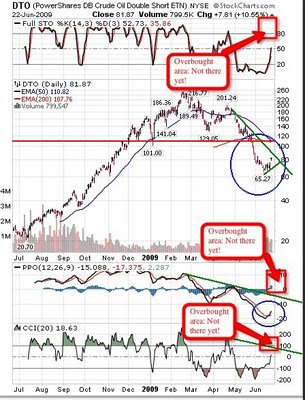 To enlarge the chart, double-click inside of it.
It had a gap open of $4. From a technical perspective, it has not reached the overbought area as measured by Stochastics, PPO, RSI, and CCI. See the following chart. If it closes the gap, I just might be interested in trading it again.
 To enlarge the chart, double-click inside of it.
Saturday, June 20, 2009
Congress and the International Monetary Fund (IMF)
This week in Washington the House approved $106 billion supplemental appropriations bill to fund our troops in Irag and Afghanistan, which also included $108 billion for the IMF. Umm! A vote against the IMF funding would be a vote against our troops. This should be an outrage to every American. These bills should be separate and voted as such. The argument that the Administration is putting forth is that it is in our vital economic interest and global security to fund the IMF $108 billion. Why? Is anyone really home out there?
It's not like the IMF doesn't have any financial resources. The IMF holds 3,217 metric tons of gold (103.4 million ounces).
Now, I am all for the funding of our troops, but I can not justify funding the IMF; which, by the way, is not such a great supporter of the United States.
This bill will now be voted on in the Senate. If you feel that funding for our troops and the IMF should be separate bills and debated on their own merits, contact your Senators and tell them as much!
It's not like the IMF doesn't have any financial resources. The IMF holds 3,217 metric tons of gold (103.4 million ounces).
Now, I am all for the funding of our troops, but I can not justify funding the IMF; which, by the way, is not such a great supporter of the United States.
This bill will now be voted on in the Senate. If you feel that funding for our troops and the IMF should be separate bills and debated on their own merits, contact your Senators and tell them as much!
S&P 500 Update for the Week Ending June 19, 2009
 Note: To enlarge chart, double-click inside of it.
Federal Open Market Committee (FOMC) meets next Wednesday. We could have volatility going into Wednesday; but, then again, that could be good for traders. However, I would settle for a trending market, either up or down. It would make one's investing life that much easier.
From an investing standpoint, that is the great benefit of using exponential moving averages (EMA), such as the 14-Week EMA and 40-Week EMA, to make investment decisions. Simply point, investors should be in stocks when the 15-Week EMA is above its 40-Week EMA; and of stocks and into money market instruments when the 15-Week EMA is below its 40-Week EMA. It doesn't get any more complicated than that.
Friday, June 19, 2009
Update on DTO
For those of you that follow me on Twitter, know that I have a position in DTO (double-inverse oil. I am in with an average cost of $71.31. DTO closed at $74.06. See my comments my comments in the following DTO chart: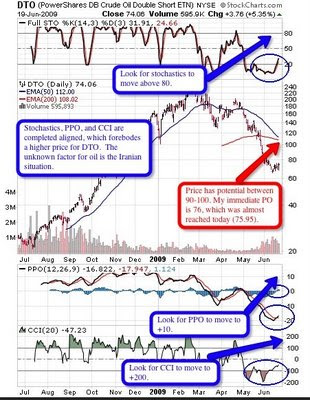
Note: To enlarge chart, double-click inside of it.
I will update my weekly S&P 500 comments over the weekend.

Note: To enlarge chart, double-click inside of it.
I will update my weekly S&P 500 comments over the weekend.
Washington is Wall Street and Wall Street is Washington
Please take the time to review the following video! It pretty much sums up my believe that the "Financial Oversight Bill" being proposed by the Fed is all about control that will further enhance the relationship between Washington and Wall Street. Main Street, you are screwed! Forgive my vulgarity, but how can we trust those individuals who put us in our current economic/financial debacle to come up with solutions to rectify the problem? Those individuals are the problem, not the solution.
Wednesday, June 17, 2009
Reflection on DTO (Double-short Oil) and USO (OIL)
I entered a trade on DTO today at $71.81 with a stop at $71.09, which turned out to be a very quick trade (loss of 1%). Saying that, I still like its potential. Please refer to the following chart for my rationale on entering the trade. On reflection, I would have done it again, because all the key technical indicators (stochastics, PPO, and CCI) were all in alignment.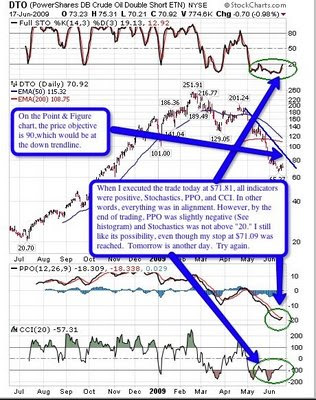 Now, take a look at USO, which is the mirror image of DTO, and tell me do you want to be long or short oil based on these two charts?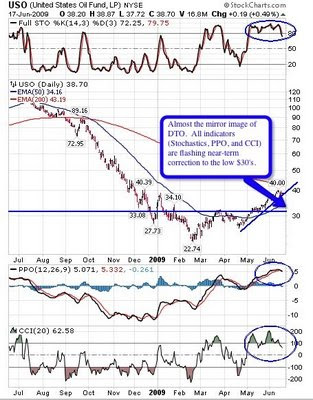
 Now, take a look at USO, which is the mirror image of DTO, and tell me do you want to be long or short oil based on these two charts?
Buy China Policy
The "Financial Times" reports today that "China has introduced an explicit “Buy Chinese” policy as part of its economic stimulus program in a move that will amplify tensions with trade partners and increase the likelihood of protectionism around the world. In an edict released jointly by nine government departments, Beijing said government procurement must use only Chinese products or services unless they were not available within the country or could not be bought on reasonable commercial or legal terms."
Anyone remember the names of Smoot and Hawley? If not, you probably better brush up on your history, especially after the government just announced that the CPI had biggest annual drop in nearly 60 years.
Anyone remember the names of Smoot and Hawley? If not, you probably better brush up on your history, especially after the government just announced that the CPI had biggest annual drop in nearly 60 years.
Obama's Iran Abdication to Sarkozy
"The President yesterday denounced the "extent of the fraud" and the "shocking" and "brutal" response of the Iranian regime to public demonstrations in Tehran these past four days. "These elections are an atrocity," he said. "If [Mahmoud] Ahmadinejad had made such progress since the last elections, if he won two-thirds of the vote, why such violence?" The statement named the regime as the cause of the outrage in Iran and, without meddling or picking favorites, stood up for Iranian democracy."
No, those words were not spoken by President Obama but France's President Nicolas Sarkozy. "The French are hardly known for their idealistic foreign policy and moral fortitude. Then again many global roles are reversing in the era of Obama."
For the complete text of the opinion expressed by the "Wall Street Journal," go to Obama's Iran Abdication.
No, those words were not spoken by President Obama but France's President Nicolas Sarkozy. "The French are hardly known for their idealistic foreign policy and moral fortitude. Then again many global roles are reversing in the era of Obama."
For the complete text of the opinion expressed by the "Wall Street Journal," go to Obama's Iran Abdication.
Twitterrific
For those of you that have an "iPhone," you can follow my inter-day market updates by downloading a free application called "Twitterrific." It is a mobile Twitter. IMHO, it is a great application for the iphone.
Tuesday, June 16, 2009
ZSL: Ultra-short Silver
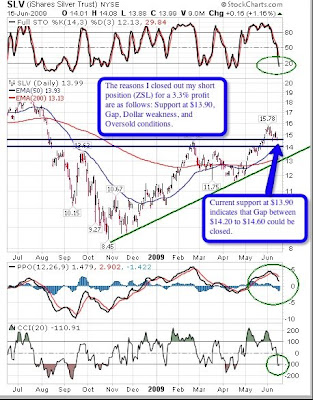
I sold my ZSL positions today for the reasons depicted in the following chart.
 Note: To enlarge chart, double-click inside of it.
 Note: To enlarge chart, double-click inside of it.
Monday, June 15, 2009
DTO (Double-short Oil), UNG (Natural Gas), and ZSL (Double-short Silver)
I removed the DTO leg at $71.61 of the DTO:UNG paired-trade today. The trade netted 5% for a 24-hour investment. As I mentioned on Twitter, I may learn to regret removing the leg. Matter of fact, in after-hour trading, DTO closed at $72.24. UNG closed the day at $15.71, which was up 7%. I still like the natural gas story and its technical picture. The other trade from Friday was ZSL, which closed at $8.79 (+10%). (See the following chart on SLV.) To say the least, it was a good day. However, I realize what the market gives, it can take!
The main reason for selling DTO, besides the 5% gain, was due to the unrest with aftermath of the Iranian election situation. If this situation implodes within Iran, oil will definitely rally.
I still maintain these markets (equities, bonds, oil, and metals) are all tied directly to what happens to the dollar. Therefore, one must pay very close attention to what happens at the BRIS meetings tomorrow.
 Note: To enlarge, double-click inside the chart.
The main reason for selling DTO, besides the 5% gain, was due to the unrest with aftermath of the Iranian election situation. If this situation implodes within Iran, oil will definitely rally.
I still maintain these markets (equities, bonds, oil, and metals) are all tied directly to what happens to the dollar. Therefore, one must pay very close attention to what happens at the BRIS meetings tomorrow.
 Note: To enlarge, double-click inside the chart.
The American Empire is Bankrupt
Please read this very important article of the BRIS meetings being held today and tomorrow by Chris Hedges in the Truthdig. An excerpt from the article is as follows:
"There are meetings being held Monday and Tuesday in Yekaterinburg, Russia, (formerly Sverdlovsk) among Chinese President Hu Jintao, Russian President Dmitry Medvedev and other top officials of the six-nation Shanghai Cooperation Organization. The United States, which asked to attend, was denied admittance. Watch what happens there carefully. The gathering is, in the words of economist Michael Hudson, “the most important meeting of the 21st century so far.”
"It is the first formal step by our major trading partners to replace the dollar as the world’s reserve currency. If they succeed, the dollar will dramatically plummet in value, the cost of imports, including oil, will skyrocket, interest rates will climb and jobs will hemorrhage at a rate that will make the last few months look like boom times. State and federal services will be reduced or shut down for lack of funds. The United States will begin to resemble the Weimar Republic or Zimbabwe."
Now, you should understand why I thought the Federal Reserve and Treasury would do everything in their power to strengthen the dollar going into the BRIS sessions. Tomorrow and Wednesday could prove very interesting for the dollar (UUP). By the way, UUP closed up 1.83% today. That for any currency is one major move.
"There are meetings being held Monday and Tuesday in Yekaterinburg, Russia, (formerly Sverdlovsk) among Chinese President Hu Jintao, Russian President Dmitry Medvedev and other top officials of the six-nation Shanghai Cooperation Organization. The United States, which asked to attend, was denied admittance. Watch what happens there carefully. The gathering is, in the words of economist Michael Hudson, “the most important meeting of the 21st century so far.”
"It is the first formal step by our major trading partners to replace the dollar as the world’s reserve currency. If they succeed, the dollar will dramatically plummet in value, the cost of imports, including oil, will skyrocket, interest rates will climb and jobs will hemorrhage at a rate that will make the last few months look like boom times. State and federal services will be reduced or shut down for lack of funds. The United States will begin to resemble the Weimar Republic or Zimbabwe."
Now, you should understand why I thought the Federal Reserve and Treasury would do everything in their power to strengthen the dollar going into the BRIS sessions. Tomorrow and Wednesday could prove very interesting for the dollar (UUP). By the way, UUP closed up 1.83% today. That for any currency is one major move.
Extended Stay Hotels Seeks Chapter 11
Extended Stay Hotels, saddled with a huge debt burden from its $8 billion top-of-the-market buyout, filed for Chapter 11 protection Monday, in one of the largest bankruptcy filings by a commercial real-estate company.
I have been warning about the problems in the commercial real-estate area for the past six months. These toxic loans will have a very negative impact on "regional banks." Extended Stay Hotels is just the "tip-of-the-iceberg."
If you want to short the commercial real-estate sector, take a look at SRS, which is a double-short ETF on this sector. It is currently trading at $19.83, which is up 9% so far today. Upside potential is at its 200-day EMA at $28. If you take the trade, set your stop at two ticks below today's low of $18.63, or $18.61.
I have been warning about the problems in the commercial real-estate area for the past six months. These toxic loans will have a very negative impact on "regional banks." Extended Stay Hotels is just the "tip-of-the-iceberg."
If you want to short the commercial real-estate sector, take a look at SRS, which is a double-short ETF on this sector. It is currently trading at $19.83, which is up 9% so far today. Upside potential is at its 200-day EMA at $28. If you take the trade, set your stop at two ticks below today's low of $18.63, or $18.61.
Twitter Comments
The following comments are from "Twitter:"

You can follow my inter-day comments by going to Twitter.

You can follow my inter-day comments by going to Twitter.
USO to UNG: Spread Trade
As mentioned on my Twitter (twitter.com/debauche), here are the details of this paired trade:
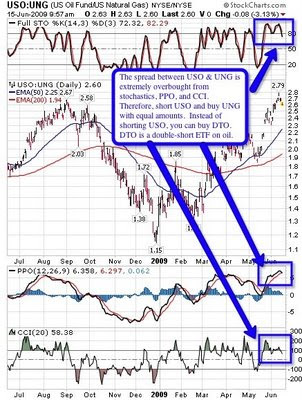
Since the vehicle of choice is DTO, double-short oil, purchase 10 shares of UNG for each DTO. Let's see what happens.

Since the vehicle of choice is DTO, double-short oil, purchase 10 shares of UNG for each DTO. Let's see what happens.
S&P 500 Weekly Update for June 12, 2009

Note: To enlarge chart, double-click inside of it.
Keep-in-mind that this is OPX option expiration week. Therefore, expect volatility! Also, the dollar's direction will determine the short-term direction for the equities, metals, and oil. That is, higher dollar, lower equities, metals, and oil.
Friday, June 12, 2009
ZSL: Ultra-short Silver
The inverse relationship between the dollar and metals (gold and silver) is playing out today. If ZSL can say above it opening price of $7.91, it can be purchased. I would rather buy ZSL than GLL. If executed, place a stop at $7.30. Upside potential for ZSL is $9.70. Overall, this is a high-risk trade.
Silver (SLV) has the potential of selling-off to $13.40-$13.90, which would be extremely positive for ZSL.
Silver (SLV) has the potential of selling-off to $13.40-$13.90, which would be extremely positive for ZSL.
House Representatives Personal Financial Disclosures
If you want to find out what your Representative disclosed in his/her financial report to Congress, check out Legistorm. Great site!
Thursday, June 11, 2009
No Executions Today on GLL and ZSL
Criteria were not met again today to take positions in GLL and ZSL. Let's see what tomorrow brings. This trade is tied directly to a stronger dollar, which would be negative for gold, oil, and silver. Long term, I am bullish on the metals and oil. Near term, I do see weakness in the metals and oil, not only because I believe the dollar will strengthen, but the metals and oil are very overbought at their respective current price levels. Could I be wrong? You bet. It would not be the first time. But I would definitely be caution near-term investing in metals and oil.
Once again, if you have a Twitter account, you can follow my inter-day updates there, especially as we approach the close.
Once again, if you have a Twitter account, you can follow my inter-day updates there, especially as we approach the close.
Today's Setup for GLL and ZSL
No execution yesterday for GLL (double inverse gold) and ZSL(double inverse silver). Both closed exactly at Tuesday's close. For today, purchase GLL and ZSL if today's close is above their open and yesterday's close (GLL @ $14.49 and ZSL @ $7.63). Enter orders only if the price going into the close (last five minutes) is above today's open and yesterday's close.
If you want an update going into the close each day, I will Twitter what I am doing. Therefore, if you have a Twitter account, you can follow me. If you don't have a Twitter account, you may want to join.
If you want an update going into the close each day, I will Twitter what I am doing. Therefore, if you have a Twitter account, you can follow me. If you don't have a Twitter account, you may want to join.
Wednesday, June 10, 2009
GLL and ZSL
No execution occurred yesterday for GLL and ZSL. GLL and ZSL closed yesterday at $14.49 and $7.63, respectively. For today, purchase GLL and ZSL if today's close is above their open and close going into the close of the day. (These orders are suppose to be entered during the last five minutes of trading.) Therefore, review price status, as indicated above, during the last thirty minutes of trading but only enter orders if the price going into the close (last five minutes) is above today's open and yesterday's close.
Tuesday, June 09, 2009
Spam Blog
I have been notified by "Blogger" that my blog is suspect of being a possible spam blog. You got to be kidding me! Therefore, those of you who have been receiving email updates of new posts will not be receiving any further such notifications.

Update on Euro Versus Dollar
 Note: To enlarge the chart, double-click inside of it.
The following two charts are GLL and ZSV, which are double-inverse bearish ETFs. These ETFs should move higher as the dollar continues to strengthen in relation to the Euro.


Thursday, June 04, 2009
EURO vs. Dollar: Near Term Impact for Gold, Oil, Silver, and Stocks

Note: To enlarge the chart, double-click inside.
Wednesday, June 03, 2009
President Obama: United States is one of the largest Muslim countries in the world!
In an interview with France's Canal Plus Television that was released on Tuesday evening, President Obama suggested that the United States might be a Muslim country. (You can read the entire transcript at Canal Plus Television.)
Wait a minute! Does anyone in the media take the time to check Obama's facts or do they simply accept his facts as gospel? The U.S. in fact has less than 1% of the world’s Muslim population of an estimated 1 billion people. The top 50 Muslim nations by percentage is here (with Muslim population figures), and the United States is not even close to being a Muslim country, let alone close to being anywhere near the top 50.
With an estimated 5 million to 8 million Muslims, Muslims are less than 3% of the U.S. population. By sheer number, the United States is far behind Indonesia (213 million), Pakistan (156 million), and Bangladesh (127 million). And, at least 23 nations have more Muslims.
Wait a minute! Does anyone in the media take the time to check Obama's facts or do they simply accept his facts as gospel? The U.S. in fact has less than 1% of the world’s Muslim population of an estimated 1 billion people. The top 50 Muslim nations by percentage is here (with Muslim population figures), and the United States is not even close to being a Muslim country, let alone close to being anywhere near the top 50.
With an estimated 5 million to 8 million Muslims, Muslims are less than 3% of the U.S. population. By sheer number, the United States is far behind Indonesia (213 million), Pakistan (156 million), and Bangladesh (127 million). And, at least 23 nations have more Muslims.
Tuesday, June 02, 2009
Ethanol's Exorbitant Cost
The "Wall Street Journal" reported today (page A11) that "The Obama Administration is pushing a big expansion in ethanol, including a mandate to increase the share of the corn-based fuel required in gasoline to 15% from 10%. Apparently no one in the Administration has read a pair of new studies, one from its own EPA, that expose ethanol as a bad deal for consumers with little environmental benefit.
The biofuels industry already receives a 45 cent tax credit for every gallon of ethanol produced, or about $3 billion a year. Meanwhile, import tariffs of 54 cents a gallon and an ad valorem tariff of four to seven cents a gallon keep out sugar-based ethanol from Brazil and the Caribbean. The federal 10% blending requirement insures a market for ethanol whether consumers want it or not -- a market Congress has mandated will double to 20.5 billion gallons in 2015.
The Congressional Budget Office reported last month that Americans pay another surcharge for ethanol in higher food prices. CBO estimates that from April 2007 to April 2008 "the increased use of ethanol accounted for about 10 percent to 15 percent of the rise in food prices." Ethanol raises food prices because millions of acres of farmland and three billion bushels of corn were diverted to ethanol from food production. Americans spend about $1.1 trillion a year on food, so in 2007 the ethanol subsidy cost families between $5.5 billion and $8.8 billion in higher grocery bills."
Readers, this is governmental absurdity. Now, I want you to visualize an America whereby the government is producing cars (Government Motors, formally General Motors), making mortgages (Fannie Mae and Freddie Mac), and running our health care systems and along with managing our postal system and Amtrak. I, for one, don't like that picture.
The biofuels industry already receives a 45 cent tax credit for every gallon of ethanol produced, or about $3 billion a year. Meanwhile, import tariffs of 54 cents a gallon and an ad valorem tariff of four to seven cents a gallon keep out sugar-based ethanol from Brazil and the Caribbean. The federal 10% blending requirement insures a market for ethanol whether consumers want it or not -- a market Congress has mandated will double to 20.5 billion gallons in 2015.
The Congressional Budget Office reported last month that Americans pay another surcharge for ethanol in higher food prices. CBO estimates that from April 2007 to April 2008 "the increased use of ethanol accounted for about 10 percent to 15 percent of the rise in food prices." Ethanol raises food prices because millions of acres of farmland and three billion bushels of corn were diverted to ethanol from food production. Americans spend about $1.1 trillion a year on food, so in 2007 the ethanol subsidy cost families between $5.5 billion and $8.8 billion in higher grocery bills."
Readers, this is governmental absurdity. Now, I want you to visualize an America whereby the government is producing cars (Government Motors, formally General Motors), making mortgages (Fannie Mae and Freddie Mac), and running our health care systems and along with managing our postal system and Amtrak. I, for one, don't like that picture.
Obama's New Deal is Really Roosevelt's "Old" New Deal
I had posted this several months ago, but I thought a little bit of redundancy is always a good technique to solidify one's learning.
Roosevelt's Treasury Secretary, Henry Morgenthau, angry at the Keynesian spenders, wrote in is his diary May 1939: "We have tried spending money. We are spending more than we have ever spent before and it does not work. And I have just one interest, and now if I am wrong somebody else can have my job. I want to see this country prosper. I want to see people get a job. I want to see people get enough to eat. We have never made good on our promises. I say after eight years of this administration, we have just as much unemployment as when we started. And enormous debt to boot."
Roosevelt's Treasury Secretary, Henry Morgenthau, angry at the Keynesian spenders, wrote in is his diary May 1939: "We have tried spending money. We are spending more than we have ever spent before and it does not work. And I have just one interest, and now if I am wrong somebody else can have my job. I want to see this country prosper. I want to see people get a job. I want to see people get enough to eat. We have never made good on our promises. I say after eight years of this administration, we have just as much unemployment as when we started. And enormous debt to boot."
Weekly Update: S&P 500 and Dollar-debased Index

Dollar-debased Fund was up 1.4% for the week. The big winner was DXO, which was up 14%, and the big loser for the week was SDS, which was down 8%. You might want to go back and review the Dollar-debased Fund from the posting of May 25, 2009.

Wednesday, May 27, 2009
How Safe is Your Bank?
You can determine the financial condition of your financial institution by going to Bankrate.com. Once at the site, move your cursor to the lower left-hand side of the site and look for "Safe and Sound Ratings." Click-on the appropriate button and follow the instructions.
Kuwait Trip: Observations on Oil and Enhanced Interrogations
The following observations on the future direction of oil prices and enhanced interrogations are from my recent trip to Kuwait:
1. Oil Prices: Kuwaitis, along with OPEC, believe that oil sometime during 2009 will be within the $75-$80 range. The rationale for the range is based on the following assumptions: (1) World economic growth, especially in U.S., is expected to occur during the second half of 2009, (2) Since gas prices have fallen below $2.50 a gallon from around $4 a gallon, demand for very small cars and hybrids has plummeted. At $2.50 per gallon, this price structure is anathema to Obama’s plan for the U.S. auto industry. (Obama's plan for auto makers to boost the average fuel efficiency of their fleets to 35.5 miles per gallon by 2016, which essentially means the auto industry will produce smaller cars and hybrids in lieu of SUVs.) Therefore, the price at the pumps must rise either through higher federal excise taxes, tacitly allowing OPEC to restrict production, or some combination of the two, and (3) With oil in the $50 range, alternative-energy sources become less attractive because they are usually more expensive to produce than traditional fossil sources. For example, ethanol, including U.S. subsidies, becomes profitable when oil is approaches $60 per barrel. Therefore, the Kuwaitis fully anticipate that the Obama administration will implement domestic and foreign polices that are conducive to higher, not lower oil prices.
2. Enhanced Interrogations: Much has been expressed and written in the media recently about the negative consequences of enhanced interrogation techniques, especially water boarding, on U.S. relations with the Arab Muslim world. According to many Kuwaitis, the reason the U.S. is disdained to the point of being called the “Great Satan” is not enhanced interrogations but the complete lack of any moral compass as depicted by movies and television shows coming out of Hollywood. Many in the Arab world, especially the Mullahs who are Islamic clergy educated in Islamic theology and sacred law, perceive the reality of the U.S. by what they watch on satellite internet and television, which is a constant streaming of sex and more sex and violence. That is their perception of Americans, which is a complete anathema to the Koran. Here in American we have been mostly desensitized to such programming but not the Arab world.
1. Oil Prices: Kuwaitis, along with OPEC, believe that oil sometime during 2009 will be within the $75-$80 range. The rationale for the range is based on the following assumptions: (1) World economic growth, especially in U.S., is expected to occur during the second half of 2009, (2) Since gas prices have fallen below $2.50 a gallon from around $4 a gallon, demand for very small cars and hybrids has plummeted. At $2.50 per gallon, this price structure is anathema to Obama’s plan for the U.S. auto industry. (Obama's plan for auto makers to boost the average fuel efficiency of their fleets to 35.5 miles per gallon by 2016, which essentially means the auto industry will produce smaller cars and hybrids in lieu of SUVs.) Therefore, the price at the pumps must rise either through higher federal excise taxes, tacitly allowing OPEC to restrict production, or some combination of the two, and (3) With oil in the $50 range, alternative-energy sources become less attractive because they are usually more expensive to produce than traditional fossil sources. For example, ethanol, including U.S. subsidies, becomes profitable when oil is approaches $60 per barrel. Therefore, the Kuwaitis fully anticipate that the Obama administration will implement domestic and foreign polices that are conducive to higher, not lower oil prices.
2. Enhanced Interrogations: Much has been expressed and written in the media recently about the negative consequences of enhanced interrogation techniques, especially water boarding, on U.S. relations with the Arab Muslim world. According to many Kuwaitis, the reason the U.S. is disdained to the point of being called the “Great Satan” is not enhanced interrogations but the complete lack of any moral compass as depicted by movies and television shows coming out of Hollywood. Many in the Arab world, especially the Mullahs who are Islamic clergy educated in Islamic theology and sacred law, perceive the reality of the U.S. by what they watch on satellite internet and television, which is a constant streaming of sex and more sex and violence. That is their perception of Americans, which is a complete anathema to the Koran. Here in American we have been mostly desensitized to such programming but not the Arab world.
Monday, May 25, 2009

Dollar-debased Fund
I have designed and implemented an index fund (portfolio) to track the irresponsible polices being set forth by our government through the Treasury Department and the Federal Reserve System. It is called the "Dollar-debased Fund". This fund is an equally weighted index whose investment objective is tied to the debasement of the U.S. dollar through the quantitative easing (QE) policy of the Federal Reserve System. This policy along with the Treasury bailouts is highly destructive to the fabric of the U.S. economy and its currency (dollar). Therefore, the fund is designed to protect investors from the insanity of the current fiscal and monetary polices of our government and Federal Reserve System, respectively. A descriptor of each investment vehicle is as follows:
1. Gold Shares (GLD): A trust (Exchange Traded Fund) that holds gold bullion.
2. Ultra-Short 20+ Treasury Bonds (TBT): The investment (Exchange Traded Fund) seeks daily investment results, which correspond to twice the inverse of the daily performance of the Lehman Brothers 20+ Year U.S. Treasury index.
3. Crude Oil (DXO): The index (Exchange Traded Note) is a rules-based index composed of futures contracts on light sweet crude oil (WTI) and is intended to reflect the performance of crude oil.
4. Ultra-Short S&P 500 Index (SDS): The investment (Exchange Traded Fund) seeks daily investment results, which correspond to twice the inverse of the daily performance of the S&P 500 index.
5. Agriculture (DBA): The index (Exchange Traded Fund) is intended to reflect the performance of the agricultural sector (Corn, Red Wheat, Soybeans, and Wheat).
For the week ended May 22, 2009, the Dollar-debased Fund stood at 1.0115 (+1.15%) from its inception of May 21, 2009.
1. Gold Shares (GLD): A trust (Exchange Traded Fund) that holds gold bullion.
2. Ultra-Short 20+ Treasury Bonds (TBT): The investment (Exchange Traded Fund) seeks daily investment results, which correspond to twice the inverse of the daily performance of the Lehman Brothers 20+ Year U.S. Treasury index.
3. Crude Oil (DXO): The index (Exchange Traded Note) is a rules-based index composed of futures contracts on light sweet crude oil (WTI) and is intended to reflect the performance of crude oil.
4. Ultra-Short S&P 500 Index (SDS): The investment (Exchange Traded Fund) seeks daily investment results, which correspond to twice the inverse of the daily performance of the S&P 500 index.
5. Agriculture (DBA): The index (Exchange Traded Fund) is intended to reflect the performance of the agricultural sector (Corn, Red Wheat, Soybeans, and Wheat).
For the week ended May 22, 2009, the Dollar-debased Fund stood at 1.0115 (+1.15%) from its inception of May 21, 2009.
Thursday, May 21, 2009
Back in U.S.A
Just arrived back in the U.S. from a fourteen hour flight from Kuwait. Long flight indeed but it makes it tolerable when you are sitting up front.
Had an opportunity to meet the U.S. Ambassador to Kuwait, Deborah Jones, during my meetings at the American University of Kuwait. Country still has not fully recovered from the 1990 Iraq-Kuwait War. There are still many tangible and intangible scars within country and especially among the Kuwaiti people. More on Kuwait later, especially as it pertains to "oil."
Had an opportunity to meet the U.S. Ambassador to Kuwait, Deborah Jones, during my meetings at the American University of Kuwait. Country still has not fully recovered from the 1990 Iraq-Kuwait War. There are still many tangible and intangible scars within country and especially among the Kuwaiti people. More on Kuwait later, especially as it pertains to "oil."
GMAC to Get a Fresh Bailout
The Wall Street Journal reports today that the Treasury Department is poised to inject more than $7 billion into GMAC, the first installment of a new government aid package that could reach $14 billion, according to people familiar with the matter.
"As a result of the move, the government within months could end up owning both GMAC and General Motors (Government (Obama) Motors. The GM plan being devised by President Obama's auto task force calls for the government to emerge with a majority stake."
"The GMAC funding is an illustration of how rapidly the government effort to rescue the U.S. auto industry is escalating in cost and scope. What began as an emergency batch of loans to GM, Chrysler and GMAC in December -- totaling just over $20 billion -- now looks likely to balloon well beyond $50 billion and could approach $100 billion by the end of the year." Unbelievable. The auto industry is fast absorbing financial resources that the Treasury had previously directed to the banking sector.
These measures will NOT work. Period! They will bankrupt this nation. No, these measures of bailout after bailout have already bankrupted this nation. Our total national debt (federal, state, municipal, and consumer) has made us a servitude nation to the rest of the world, especially China. Proverbs 22:7 states, "The rich rule over the poor, and the borrower is servant to the lender." In other words, the nation who has the gold makes the rules. Folks, America does not have any gold. We have sold off our birthright, and we don't even realize it.
"As a result of the move, the government within months could end up owning both GMAC and General Motors (Government (Obama) Motors. The GM plan being devised by President Obama's auto task force calls for the government to emerge with a majority stake."
"The GMAC funding is an illustration of how rapidly the government effort to rescue the U.S. auto industry is escalating in cost and scope. What began as an emergency batch of loans to GM, Chrysler and GMAC in December -- totaling just over $20 billion -- now looks likely to balloon well beyond $50 billion and could approach $100 billion by the end of the year." Unbelievable. The auto industry is fast absorbing financial resources that the Treasury had previously directed to the banking sector.
These measures will NOT work. Period! They will bankrupt this nation. No, these measures of bailout after bailout have already bankrupted this nation. Our total national debt (federal, state, municipal, and consumer) has made us a servitude nation to the rest of the world, especially China. Proverbs 22:7 states, "The rich rule over the poor, and the borrower is servant to the lender." In other words, the nation who has the gold makes the rules. Folks, America does not have any gold. We have sold off our birthright, and we don't even realize it.
Wednesday, May 20, 2009
Why Government Can't (And Shouldn't) Run a Business
On today's (May 20, 2009) Opinion Page of the Wall Street Journal, John Gordon, who is the author of "An Empire of Wealth: The Epic History of American Economic Power," writes an excellent treatise that simply states politicians need headlines and markets need profits to survive. The entire article is a must read, which is provided in its entirety as follows:
"The Obama administration is bent on becoming a major player in -- if not taking over entirely -- America's health-care, automobile and banking industries. Before that happens, it might be a good idea to look at the government's track record in running economic enterprises. It is terrible.
In 1913, for instance, thinking it was being overcharged by the steel companies for armor plate for warships, the federal government decided to build its own plant. It estimated that a plant with a 10,000-ton annual capacity could produce armor plate for only 70% of what the steel companies charged.
When the plant was finally finished, however -- three years after World War I had ended -- it was millions over budget and able to produce armor plate only at twice what the steel companies charged. It produced one batch and then shut down, never to reopen.
Or take Medicare. Other than the source of its premiums, Medicare is no different, economically, than a regular health-insurance company. But unlike, say, UnitedHealthcare, it is a bureaucracy-beclotted nightmare, riven with waste and fraud. Last year the Government Accountability Office estimated that no less than one-third of all Medicare disbursements for durable medical equipment, such as wheelchairs and hospital beds, were improper or fraudulent. Medicare was so lax in its oversight that it was approving orthopedic shoes for amputees.
These examples are not aberrations; they are typical of how governments run enterprises. There are a number of reasons why this is inherently so. Among them are:
1) Governments are run by politicians, not businessmen. Politicians can only make political decisions, not economic ones. They are, after all, first and foremost in the re-election business. Because of the need to be re-elected, politicians are always likely to have a short-term bias. What looks good right now is more important to politicians than long-term consequences even when those consequences can be easily foreseen. The gathering disaster of Social Security has been obvious for years, but politics has prevented needed reforms.
And politicians tend to favor parochial interests over sound economic sense. Consider a thought experiment. There is a national widget crisis and Sen. Wiley Snoot is chairman of the Senate Widget Committee. There are two technologies that are possible solutions to the problem, with Technology A widely thought to be the more promising of the two. But the company that has been developing Technology B is headquartered in Sen. Snoot's state and employs 40,000 workers there. Which technology is Sen. Snoot going to use his vast legislative influence to push?
2) Politicians need headlines. And this means they have a deep need to do something ("Sen. Snoot Moves on Widget Crisis!"), even when doing nothing would be the better option. Markets will always deal efficiently with gluts and shortages, but letting the market work doesn't produce favorable headlines and, indeed, often produces the opposite ("Sen. Snoot Fails to Move on Widget Crisis!").
3) Governments use other people's money. Corporations play with their own money. They are wealth-creating machines in which various people (investors, managers and labor) come together under a defined set of rules in hopes of creating more wealth collectively than they can create separately.
So a labor negotiation in a corporation is a negotiation over how to divide the wealth that is created between stockholders and workers. Each side knows that if they drive too hard a bargain they risk killing the goose that lays golden eggs for both sides. Just ask General Motors and the United Auto Workers.
But when, say, a school board sits down to negotiate with a teachers union or decide how many administrators are needed, the goose is the taxpayer. That's why public-service employees now often have much more generous benefits than their private-sector counterparts. And that's why the New York City public school system had an administrator-to-student ratio 10 times as high as the city's Catholic school system, at least until Mayor Michael Bloomberg (a more than competent businessman before he entered politics) took charge of the system.
4) Government does not tolerate competition. The Obama administration is talking about creating a "public option" that would compete in the health-insurance marketplace with profit-seeking companies. But has a government entity ever competed successfully on a level playing field with private companies? I don't know of one.
5) Government enterprises are almost always monopolies and thus do not face competition at all. But competition is exactly what makes capitalism so successful an economic system. The lack of it has always doomed socialist economies.
When the federal government nationalized the phone system in 1917, justifying it as a wartime measure that would lower costs, it turned it over to the Post Office to run. (The process was called "postalization," a word that should send shivers down the back of any believer in free markets.) But despite the promise of lower prices, practically the first thing the Post Office did when it took over was . . . raise prices.
Cost cutting is alien to the culture of all bureaucracies. Indeed, when cost cutting is inescapable, bureaucracies often make cuts that will produce maximum public inconvenience, generating political pressure to reverse the cuts.
6) Successful corporations are run by benevolent despots. The CEO of a corporation has the power to manage effectively. He decides company policy, organizes the corporate structure, and allocates resources pretty much as he thinks best. The board of directors ordinarily does nothing more than ratify his moves (or, of course, fire him). This allows a company to act quickly when needed.
But American government was designed by the Founding Fathers to be inefficient, and inefficient it most certainly is. The president is the government's CEO, but except for trivial matters he can't do anything without the permission of two separate, very large committees (the House and Senate) whose members have their own political agendas. Government always has many cooks, which is why the government's broth is so often spoiled.
7) Government is regulated by government. When "postalization" of the nation's phone system appeared imminent in 1917, Theodore Vail, the president of AT&T, admitted that his company was, effectively, a monopoly. But he noted that "all monopolies should be regulated. Government ownership would be an unregulated monopoly."
It is government's job to make and enforce the rules that allow a civilized society to flourish. But it has a dismal record of regulating itself. Imagine, for instance, if a corporation, seeking to make its bottom line look better, transferred employee contributions from the company pension fund to its own accounts, replaced the money with general obligation corporate bonds, and called the money it expropriated income. We all know what would happen: The company accountants would refuse to certify the books and management would likely -- and rightly -- end up in jail.
But that is exactly what the federal government (which, unlike corporations, decides how to keep its own books) does with Social Security. In the late 1990s, the government was running what it -- and a largely unquestioning Washington press corps -- called budget "surpluses." But the national debt still increased in every single one of those years because the government was borrowing money to create the "surpluses."
Capitalism isn't perfect. Indeed, to paraphrase Winston Churchill's famous description of democracy, it's the worst economic system except for all the others. But the inescapable fact is that only the profit motive and competition keep enterprises lean, efficient, innovative and customer-oriented."
Please go back and read again the last three paragraphs, which are in bold, to get a full understanding on how perverted Washington's thinking is. This type of insanity must stop now, not tomorrow but now! Copy this article and send it to your Senators and Representative and request them to stop all this insanity. (Insanity is defined as continuing to do the same things over and over and expecting a different outcome.) Tell them to stop interfering and meddling with our market economy. If they will not lesson to your reason of sanity, tell them directly you will vote for someone next time who is does believe in the workings of a market economy.
To find your Representative go to the House of Representatives and to find your Senators go to United States Senate.
"The Obama administration is bent on becoming a major player in -- if not taking over entirely -- America's health-care, automobile and banking industries. Before that happens, it might be a good idea to look at the government's track record in running economic enterprises. It is terrible.
In 1913, for instance, thinking it was being overcharged by the steel companies for armor plate for warships, the federal government decided to build its own plant. It estimated that a plant with a 10,000-ton annual capacity could produce armor plate for only 70% of what the steel companies charged.
When the plant was finally finished, however -- three years after World War I had ended -- it was millions over budget and able to produce armor plate only at twice what the steel companies charged. It produced one batch and then shut down, never to reopen.
Or take Medicare. Other than the source of its premiums, Medicare is no different, economically, than a regular health-insurance company. But unlike, say, UnitedHealthcare, it is a bureaucracy-beclotted nightmare, riven with waste and fraud. Last year the Government Accountability Office estimated that no less than one-third of all Medicare disbursements for durable medical equipment, such as wheelchairs and hospital beds, were improper or fraudulent. Medicare was so lax in its oversight that it was approving orthopedic shoes for amputees.
These examples are not aberrations; they are typical of how governments run enterprises. There are a number of reasons why this is inherently so. Among them are:
1) Governments are run by politicians, not businessmen. Politicians can only make political decisions, not economic ones. They are, after all, first and foremost in the re-election business. Because of the need to be re-elected, politicians are always likely to have a short-term bias. What looks good right now is more important to politicians than long-term consequences even when those consequences can be easily foreseen. The gathering disaster of Social Security has been obvious for years, but politics has prevented needed reforms.
And politicians tend to favor parochial interests over sound economic sense. Consider a thought experiment. There is a national widget crisis and Sen. Wiley Snoot is chairman of the Senate Widget Committee. There are two technologies that are possible solutions to the problem, with Technology A widely thought to be the more promising of the two. But the company that has been developing Technology B is headquartered in Sen. Snoot's state and employs 40,000 workers there. Which technology is Sen. Snoot going to use his vast legislative influence to push?
2) Politicians need headlines. And this means they have a deep need to do something ("Sen. Snoot Moves on Widget Crisis!"), even when doing nothing would be the better option. Markets will always deal efficiently with gluts and shortages, but letting the market work doesn't produce favorable headlines and, indeed, often produces the opposite ("Sen. Snoot Fails to Move on Widget Crisis!").
3) Governments use other people's money. Corporations play with their own money. They are wealth-creating machines in which various people (investors, managers and labor) come together under a defined set of rules in hopes of creating more wealth collectively than they can create separately.
So a labor negotiation in a corporation is a negotiation over how to divide the wealth that is created between stockholders and workers. Each side knows that if they drive too hard a bargain they risk killing the goose that lays golden eggs for both sides. Just ask General Motors and the United Auto Workers.
But when, say, a school board sits down to negotiate with a teachers union or decide how many administrators are needed, the goose is the taxpayer. That's why public-service employees now often have much more generous benefits than their private-sector counterparts. And that's why the New York City public school system had an administrator-to-student ratio 10 times as high as the city's Catholic school system, at least until Mayor Michael Bloomberg (a more than competent businessman before he entered politics) took charge of the system.
4) Government does not tolerate competition. The Obama administration is talking about creating a "public option" that would compete in the health-insurance marketplace with profit-seeking companies. But has a government entity ever competed successfully on a level playing field with private companies? I don't know of one.
5) Government enterprises are almost always monopolies and thus do not face competition at all. But competition is exactly what makes capitalism so successful an economic system. The lack of it has always doomed socialist economies.
When the federal government nationalized the phone system in 1917, justifying it as a wartime measure that would lower costs, it turned it over to the Post Office to run. (The process was called "postalization," a word that should send shivers down the back of any believer in free markets.) But despite the promise of lower prices, practically the first thing the Post Office did when it took over was . . . raise prices.
Cost cutting is alien to the culture of all bureaucracies. Indeed, when cost cutting is inescapable, bureaucracies often make cuts that will produce maximum public inconvenience, generating political pressure to reverse the cuts.
6) Successful corporations are run by benevolent despots. The CEO of a corporation has the power to manage effectively. He decides company policy, organizes the corporate structure, and allocates resources pretty much as he thinks best. The board of directors ordinarily does nothing more than ratify his moves (or, of course, fire him). This allows a company to act quickly when needed.
But American government was designed by the Founding Fathers to be inefficient, and inefficient it most certainly is. The president is the government's CEO, but except for trivial matters he can't do anything without the permission of two separate, very large committees (the House and Senate) whose members have their own political agendas. Government always has many cooks, which is why the government's broth is so often spoiled.
7) Government is regulated by government. When "postalization" of the nation's phone system appeared imminent in 1917, Theodore Vail, the president of AT&T, admitted that his company was, effectively, a monopoly. But he noted that "all monopolies should be regulated. Government ownership would be an unregulated monopoly."
It is government's job to make and enforce the rules that allow a civilized society to flourish. But it has a dismal record of regulating itself. Imagine, for instance, if a corporation, seeking to make its bottom line look better, transferred employee contributions from the company pension fund to its own accounts, replaced the money with general obligation corporate bonds, and called the money it expropriated income. We all know what would happen: The company accountants would refuse to certify the books and management would likely -- and rightly -- end up in jail.
But that is exactly what the federal government (which, unlike corporations, decides how to keep its own books) does with Social Security. In the late 1990s, the government was running what it -- and a largely unquestioning Washington press corps -- called budget "surpluses." But the national debt still increased in every single one of those years because the government was borrowing money to create the "surpluses."
Capitalism isn't perfect. Indeed, to paraphrase Winston Churchill's famous description of democracy, it's the worst economic system except for all the others. But the inescapable fact is that only the profit motive and competition keep enterprises lean, efficient, innovative and customer-oriented."
Please go back and read again the last three paragraphs, which are in bold, to get a full understanding on how perverted Washington's thinking is. This type of insanity must stop now, not tomorrow but now! Copy this article and send it to your Senators and Representative and request them to stop all this insanity. (Insanity is defined as continuing to do the same things over and over and expecting a different outcome.) Tell them to stop interfering and meddling with our market economy. If they will not lesson to your reason of sanity, tell them directly you will vote for someone next time who is does believe in the workings of a market economy.
To find your Representative go to the House of Representatives and to find your Senators go to United States Senate.
Friday, May 15, 2009
Short Hiatus
I will be in Kuwait over the next week. Therefore, my postings will be very limited, if any at all.

Thursday, May 14, 2009
Government Motors (GM): Chinese-Made Cars to USA!
As thousands of GM workers await word on more U.S. plant closures, reports are circulating that the company plans to import Chinese-made vehicles to the U.S., which, of course, have created a political problem for the automaker and the White House.
On Wednesday, May 13, Shanghai Securities News and other Chinese media reported that GM plans to begin exporting vehicles from China to the U.S. within two years and more than 50,000 by 2014.
This should not come as a surprise to the readers of this blog, because on February 9, 2009 the title of that day's blog was "General Motors to Invest $1 Billion in Brazil Operations -- Money to Come from U.S. Rescue Program."
On Wednesday, May 13, Shanghai Securities News and other Chinese media reported that GM plans to begin exporting vehicles from China to the U.S. within two years and more than 50,000 by 2014.
This should not come as a surprise to the readers of this blog, because on February 9, 2009 the title of that day's blog was "General Motors to Invest $1 Billion in Brazil Operations -- Money to Come from U.S. Rescue Program."
Tuesday, May 12, 2009
U.S. Treasury to Borrow 46 Cents for Every Dollar Spent
The government will have to borrow nearly 50 cents for every dollar it spends this year, exploding the record federal deficit past $1.8 trillion under new White House estimates. Budget office figures released Monday would add $89 billion to the 2009 red ink - increasing it to more than four times last year's all-time high as the government hands out billions more than expected for people who have lost jobs and takes in less tax revenue from people and companies making less money.
The deficit for the 2010 budget year beginning in October will worsen by $87 billion to $1.3 trillion, the White House says. The deterioration reflects lower tax revenues and higher costs for bank failures, unemployment benefits and food stamps.
The deficit for the 2010 budget year beginning in October will worsen by $87 billion to $1.3 trillion, the White House says. The deterioration reflects lower tax revenues and higher costs for bank failures, unemployment benefits and food stamps.
Monday, May 11, 2009
Is Higher Education the Reason for Obama's Blame America Rhetoric?
Dorthy Rabinowitz, who is a member of the Wall Street Journal's editorial board, writes in the "Wall Street Journal" on April 22, 2009 that higher education over the past 50 years has adopted a very liberal orientation within the professorial ranks.
A direct quote from her article is as follows: "None of this display during Mr. Obama's recent travels could have come as a surprise to legions of his supporters, nor would many of them be daunted by their new president's preoccupation with American's moral failures. Five decades of teaching in colleges and universities across the land, portraying the United States as a power mainly responsible for injustice and evil, whose military might was ever a danger to the world -- a nation built on the fruits of greed, rapacity and racism -- have had their effect. The products of this education find nothing strange in a president quick to focus on the theme of American moral failure."
For the complete article, click-on "Obama Blames America."
A direct quote from her article is as follows: "None of this display during Mr. Obama's recent travels could have come as a surprise to legions of his supporters, nor would many of them be daunted by their new president's preoccupation with American's moral failures. Five decades of teaching in colleges and universities across the land, portraying the United States as a power mainly responsible for injustice and evil, whose military might was ever a danger to the world -- a nation built on the fruits of greed, rapacity and racism -- have had their effect. The products of this education find nothing strange in a president quick to focus on the theme of American moral failure."
For the complete article, click-on "Obama Blames America."
Sunday, May 10, 2009

Is Anyone Minding the Store at the Federal Reserve?
Some very simple questions with perfunctory responses by the Inspector General of the Federal Reserve System.
Thursday, May 07, 2009
New York Federal Reserve President RESIGNS!
The "Wall Street Journal" reports in today's edition that the Federal Reserve Bank of New York's Chairman, Stephen Friedman, resigned amid a controversy about his dual roles as a director of the Fed bank and a director and shareholder of Goldman Sachs Group. Why is this important? Because the Federal Reserve Bank of New York is a policy-making body, and the Federal Reserve System is a primary banking system regulator. Once Goldman converted to a bank holding company, it fell under the Fed jurisdiction. Oh, that would be under the purview of Stephen Friedman.
According to Karl Kenninger over at the "Market Ticker," during that time, Mr. Friedman sat on Goldman's board and had a large holding in Goldman stock, which because of Goldman's new status as a bank holding company was a violation of Federal Reserve policy. The New York Fed asked for a waiver, which, after about 2½ months, the Fed granted. (No kidding) While it was weighing the request, Mr. Friedman bought 37,300 more Goldman shares in December of 2008. These shares have since risen $1.7 million in value. I believe what Mr. Friedman did was highly illegal, because it amounts to insider trading. Let's see if the SEC is going to prosecute him for insider trading. Don't hold your breath.
I just wonder how many top Fed and Treasury officials have a direct tie to Goldman Sachs, or, for that matter, to Wall Street?
According to Karl Kenninger over at the "Market Ticker," during that time, Mr. Friedman sat on Goldman's board and had a large holding in Goldman stock, which because of Goldman's new status as a bank holding company was a violation of Federal Reserve policy. The New York Fed asked for a waiver, which, after about 2½ months, the Fed granted. (No kidding) While it was weighing the request, Mr. Friedman bought 37,300 more Goldman shares in December of 2008. These shares have since risen $1.7 million in value. I believe what Mr. Friedman did was highly illegal, because it amounts to insider trading. Let's see if the SEC is going to prosecute him for insider trading. Don't hold your breath.
I just wonder how many top Fed and Treasury officials have a direct tie to Goldman Sachs, or, for that matter, to Wall Street?
GM Loses Another $6 billion
GM's financial woes continue as the automaker reported a $6 billion loss during the first three months of the year Thursday. The Wall Street Journal reports that "GM burned through $10.2 billion in the quarter as revenue plunged nearly 50%. As recently as a February 17 filing to the government, GM was projecting that it would burn through only $4.1 billion in cash in the period. This is just another sign GM is running out of options as it races to meet a June 1 restructuring deadline set by the Obama administration. The company is surviving on $15.4 billion in federal loans and has said it needs another $11.6 billion to stay afloat. The losses aren't expected to let up soon. GM will idle most its assembly plants this summer, further slashing revenue. The auto maker's revenue fell by $20 billion, or 47%, as sales fell around the world."
"GM Chief Executive Fritz Henderson, while hoping to avoid a bankruptcy filing, has acknowledged the scenario is increasingly likely. The company needs 90% of bondholders to sign off on a deal to exchange $27 billion in debt for 10% of the company's stock. The union also must agree to accept equity in exchange for at least half of the $20 billion GM owes into a retiree health-care trust."
Please let's just euthanize it. We, the American taxpayers, have already given GM $15.4 billion. I definitely believe that American taxpayers do not want to invest another $11.6 billion into this "black hole." Like Chrysler, billions were provided that just delayed the inevitable, bankruptcy. It looks like we are using this same model for GM. Pump billions of taxpayer dollars into GM, which it does not stand a chance to survive. In other words, just more money down the proverbial rat hole.
Let's look at some sobering statistics, especially if you are not a GM worker, that assumes GM will receive the additional $11.6 billion dollars. With these additional billions, the American taxpayers will have provided $27 billion to GM. GM currently has a workforce of approximately 50,000. This amounts to a staggering $540,000 for each GM worker! If we look at GM's legacy side, (approximately 432,000 retired persons and their spouses), this amounts to $62,500 for each one. I guess paying all those union dues are worth it after all. However, it should not be at the expense of the American taxpayers.
"GM Chief Executive Fritz Henderson, while hoping to avoid a bankruptcy filing, has acknowledged the scenario is increasingly likely. The company needs 90% of bondholders to sign off on a deal to exchange $27 billion in debt for 10% of the company's stock. The union also must agree to accept equity in exchange for at least half of the $20 billion GM owes into a retiree health-care trust."
Please let's just euthanize it. We, the American taxpayers, have already given GM $15.4 billion. I definitely believe that American taxpayers do not want to invest another $11.6 billion into this "black hole." Like Chrysler, billions were provided that just delayed the inevitable, bankruptcy. It looks like we are using this same model for GM. Pump billions of taxpayer dollars into GM, which it does not stand a chance to survive. In other words, just more money down the proverbial rat hole.
Let's look at some sobering statistics, especially if you are not a GM worker, that assumes GM will receive the additional $11.6 billion dollars. With these additional billions, the American taxpayers will have provided $27 billion to GM. GM currently has a workforce of approximately 50,000. This amounts to a staggering $540,000 for each GM worker! If we look at GM's legacy side, (approximately 432,000 retired persons and their spouses), this amounts to $62,500 for each one. I guess paying all those union dues are worth it after all. However, it should not be at the expense of the American taxpayers.
Wednesday, May 06, 2009
1934 Chicago Tribune Cartoon Asks–Planned Economy Or Planned Destruction?
Take a look at this cartoon published in the Chicago Tribune on April 21, 1934 titled, “PLANNED ECONOMY OR PLANNED DESTRUCTION?” We're so much wiser these days, aren't we?


Tuesday, May 05, 2009
Cash-for-Clunkers
Democrats and President Obama have agreed on "Cash-for-Clunkers Plan." Eligible drivers would receive a reimbursement voucher for the purchase of a new or used vehicle with a fuel economy rating that exceeds the CAFE target for that class of vehicle by at least 25 percent. The bill also requires that the voucher be used towards the purchase of a vehicle that has an MSRP of less than $45,000, is model year 2004 or later, and meets or exceeds federal emissions standards. Vouchers could also be redeemed for transit fares for participating local public transportation agencies.
Drivers, who apply for the program, must ensure that their vehicles turned in for scrapping match the following criteria:
• Vehicles must be in drivable condition;
• Be currently registered in the U.S.; and
• Have a when-new fuel economy rating of less than 18 miles per gallon (as reported by the original manufacturer for purposes of CAFE compliance).
The bill specifies that during the first year of the program, vouchers will be issued for the following amounts:
For traded-in vehicles that are model year 2002 and later, drivers would receive a voucher for:
1. The purchase of a new vehicle: $4,500
2. The purchase of a used vehicle: $3,000
3. Transit fare credit: $3,000
For traded-in vehicles that are model year 1999 – 2001, drivers would receive a voucher for:
1. The purchase of a new vehicle: $3,000
2. The purchase of a used vehicle: $2,000
3. Transit fare credit: $2,000
For traded-in vehicles that are model year 1998 and earlier, drivers would receive a voucher for:
1. The purchase of a new vehicle: $2,000
2. The purchase of a used vehicle: $1,500
3. Transit fare credit: $1,500
In each subsequent year (2010, 2011, and 2012), the model years would be advanced by one year. Vouchers would be eligible for redemption for up to two years after the date of issuance, and no individual would be eligible to obtain more than one voucher in any three-year period. Dealers and scrap recycling facilities would also be eligible for a payment of $50 per vehicle, or an alternative amount to be specified by the Department of Energy.
Therefore, if you have a 2003 Escalade that is worth $15,000 on the open market, the government will give you $4,500 for it. But if you have a 1998 Ford Expedition that is worth $3,500, the government will give you $2,000 for it.
Don't we live a great country. You have to love it. By the way, I have to sign-off and get to the junk yard before it closes. However, I will leave you with a "sound-bite" from the announcement about the "Cash for Clunkers" by Obama, Bernanke, and Geithner.
Drivers, who apply for the program, must ensure that their vehicles turned in for scrapping match the following criteria:
• Vehicles must be in drivable condition;
• Be currently registered in the U.S.; and
• Have a when-new fuel economy rating of less than 18 miles per gallon (as reported by the original manufacturer for purposes of CAFE compliance).
The bill specifies that during the first year of the program, vouchers will be issued for the following amounts:
For traded-in vehicles that are model year 2002 and later, drivers would receive a voucher for:
1. The purchase of a new vehicle: $4,500
2. The purchase of a used vehicle: $3,000
3. Transit fare credit: $3,000
For traded-in vehicles that are model year 1999 – 2001, drivers would receive a voucher for:
1. The purchase of a new vehicle: $3,000
2. The purchase of a used vehicle: $2,000
3. Transit fare credit: $2,000
For traded-in vehicles that are model year 1998 and earlier, drivers would receive a voucher for:
1. The purchase of a new vehicle: $2,000
2. The purchase of a used vehicle: $1,500
3. Transit fare credit: $1,500
In each subsequent year (2010, 2011, and 2012), the model years would be advanced by one year. Vouchers would be eligible for redemption for up to two years after the date of issuance, and no individual would be eligible to obtain more than one voucher in any three-year period. Dealers and scrap recycling facilities would also be eligible for a payment of $50 per vehicle, or an alternative amount to be specified by the Department of Energy.
Therefore, if you have a 2003 Escalade that is worth $15,000 on the open market, the government will give you $4,500 for it. But if you have a 1998 Ford Expedition that is worth $3,500, the government will give you $2,000 for it.
Don't we live a great country. You have to love it. By the way, I have to sign-off and get to the junk yard before it closes. However, I will leave you with a "sound-bite" from the announcement about the "Cash for Clunkers" by Obama, Bernanke, and Geithner.
Chrysler Forecast Profit - 2012
The "Wall Street Journal" reports that Chrysler reported it lost nearly $17 billion last year but predicted it can return to profitability by 2012 if it can exit bankruptcy quickly and form an alliance with Fiat. Well now, let's break out the champagne and celebrate! Does anyone really believe this prognostication. Let's get real; but, then again, the current positive perception of "good times are here again" is much better than any real dose of economic reality. However, let's start the celebration with some "Three Dog Night."
Monday, May 04, 2009

Fairness
Our government (American Taxpayer) is spending $12 billion to save 54,000 Chrysler jobs, which is $22,000/job. With 600,000+ jobs a month being lost in the United States, why are these 54,000 jobs "more special" than those of the rest of the unemployed, who get a "fraction" of that amount in unemployment benefits?
Saturday, May 02, 2009
UAW Prevail Over Main Street and Wall Street in Chrysler Deal
The following comments (My comments are in bold.) are excerpts from an excellent article by Andrew Bary in this week's "Barron's:
President Obama blamed Chrysler's bankruptcy on "speculators," but the real problem was that the government's plan gave too much to the UAW and not enough to creditors. That Mr. President is what killed the deal!
If the secured creditors holding $6.9 billion in claims had been offered anything close to what the administration wants to give the United Auto Workers, there would have been no bankruptcy filing by Chrysler.
In the bizarre pecking order offered by the administration, the unions, which are at the bottom of Chrysler's capital structure, would get nearly full recovery value for their $10.6 billion retiree health-care claims, while the secured creditors at the top of the hierarchy would receive about 30 cents on the dollar.
Credit that to politics and a likely desire by Obama to reward the powerful UAW. After all, who in America really cares about a group of deep-pocketed banks and investment firms holding the $6.9 billion of Chrysler debt? "I don't stand with them," as Obama said of the dissidents who derailed the deal.
Another surprising aspect, which is detrimental to Main Street (American Taxpayer) of the Obama proposal was the willingness of the Treasury to forgive a $4 billion loan to the company made in December in return for an 8% stake in the restructured auto maker. An interest that could be worth only 20 cents on the dollar assuming new Chrysler's equity is valued at $10 billion.
President Obama, meanwhile, asked little sacrifice of Chrysler's unions. The administration proposed giving them a $4.6 billion note yielding 9% due in 2022, and 55% of the equity in a restructured Chrysler. That could mean a nearly full recovery of their $10.6 billion claim.
Let's see if I understand what President Obama tried to do. He gives the UAW, which is a unsecured creditor, 100% on its claim of $10.6 billion. Then, he gives the American taxpayer, which does have a secured position in its claim of $4 billion, $.20 on the dollar. Finally, other secured creditors (401k investors, mutual fund investors, etc.), who have claims of $6.9 billion, were given $.30. In other words, the UAW was offered a "lush deal" even though its claim is junior to the claims of Chrysler's other major creditors, including the American taxpayer.
One more thought. If Chrysler couldn't figure out how to make efficient cars from their partnership with Daimler-Benz, are they now going to become viable through a partnership with the U.S. Federal Government (think U.S. Postal System and Amtrak) and Fiat, which has been on the verge of bankruptcy for the last decade? Really? GM paid $2 billion in penalties to Fiat in 2005 so as to not be forced to buy them. And Fiat gets 20% for no cash? Wow! Where can I buy the stock? I want a piece of this action. (LOL)
President Obama blamed Chrysler's bankruptcy on "speculators," but the real problem was that the government's plan gave too much to the UAW and not enough to creditors. That Mr. President is what killed the deal!
If the secured creditors holding $6.9 billion in claims had been offered anything close to what the administration wants to give the United Auto Workers, there would have been no bankruptcy filing by Chrysler.
In the bizarre pecking order offered by the administration, the unions, which are at the bottom of Chrysler's capital structure, would get nearly full recovery value for their $10.6 billion retiree health-care claims, while the secured creditors at the top of the hierarchy would receive about 30 cents on the dollar.
Credit that to politics and a likely desire by Obama to reward the powerful UAW. After all, who in America really cares about a group of deep-pocketed banks and investment firms holding the $6.9 billion of Chrysler debt? "I don't stand with them," as Obama said of the dissidents who derailed the deal.
Another surprising aspect, which is detrimental to Main Street (American Taxpayer) of the Obama proposal was the willingness of the Treasury to forgive a $4 billion loan to the company made in December in return for an 8% stake in the restructured auto maker. An interest that could be worth only 20 cents on the dollar assuming new Chrysler's equity is valued at $10 billion.
President Obama, meanwhile, asked little sacrifice of Chrysler's unions. The administration proposed giving them a $4.6 billion note yielding 9% due in 2022, and 55% of the equity in a restructured Chrysler. That could mean a nearly full recovery of their $10.6 billion claim.
Let's see if I understand what President Obama tried to do. He gives the UAW, which is a unsecured creditor, 100% on its claim of $10.6 billion. Then, he gives the American taxpayer, which does have a secured position in its claim of $4 billion, $.20 on the dollar. Finally, other secured creditors (401k investors, mutual fund investors, etc.), who have claims of $6.9 billion, were given $.30. In other words, the UAW was offered a "lush deal" even though its claim is junior to the claims of Chrysler's other major creditors, including the American taxpayer.
One more thought. If Chrysler couldn't figure out how to make efficient cars from their partnership with Daimler-Benz, are they now going to become viable through a partnership with the U.S. Federal Government (think U.S. Postal System and Amtrak) and Fiat, which has been on the verge of bankruptcy for the last decade? Really? GM paid $2 billion in penalties to Fiat in 2005 so as to not be forced to buy them. And Fiat gets 20% for no cash? Wow! Where can I buy the stock? I want a piece of this action. (LOL)
Friday, May 01, 2009
Chrysler Bankruptcy
Yesterday, Chrysler filed for Chapter 11 bankruptcy protection. This is how the Chrysler collapse should have been worked out last December, when the auto maker first went looking for taxpayer cash. Treasury could have saved the American taxpayer $4 billion that we lent the car maker at that time, to which we can now add another $8 billion that President Obama promised yesterday to keep the company going. Now, in all fairness, Mr. Bush should never have given the car makers a "dime" in December.
"In announcing Chrysler's bankruptcy, it was especially rich for President Obama to blast the "creditors" for seeking "an unjustified taxpayer-funded bailout" while offering the UAW a 55% majority stake in Chrysler. He also praised the large banks, Citibank, J.P. Morgan Chase, Morgan Stanley and Goldman Sachs, that hold most of the Chrysler debt (70%) and supported the government plan. But of course Citibank and the other big banks are also recipients of billions of dollars in taxpayer cash and have a strong interest in playing nice with their creditor, Uncle Sam Obama."
"The Chrysler "creditors" at least represent teachers, pensioners and retirees, among others. The Administration is advancing its own social and political agenda through its ever-deeper entanglement with Chrysler and General Motors. That explains why the government is giving 55% of the new Chrysler to the UAW's retiree-benefit trust, a junior creditor, while those ahead of the trust in line get a mere 30 cents on the dollar." Priceless, isn't it? Here you have a President that wants to completely ignore contract law.
I remember President Obama saying that bankruptcy was never a "viable option" for any of the domestic car makers. What happen, President Obama? Why then, did we sink billions and billions of tax payers dollars into a firm that every financial analyst knew could not survive outside of a structured bankruptcy? Questions I don't see anyone in the media asking.
The federal bankruptcy judge assigned to the Chrysler case is used to dealing with complicated high-profile cases. The judge, Arthur J. Gonzalez, oversaw the reorganization of Enron in 2001, which set a record by filing for bankruptcy with $63 billion in assets, and WorldCom in 2002, which topped Enron with $107 billion assets when it filed.
Therefore, bankruptcy, not the Treasury, is the fairest venue for all parties. Come the end of May, we will undoubtedly see GM seating along side of Chrysler before Judge Gonzales.
Source: Wall Street Journal (Opinion Section), May 1, 2009
"In announcing Chrysler's bankruptcy, it was especially rich for President Obama to blast the "creditors" for seeking "an unjustified taxpayer-funded bailout" while offering the UAW a 55% majority stake in Chrysler. He also praised the large banks, Citibank, J.P. Morgan Chase, Morgan Stanley and Goldman Sachs, that hold most of the Chrysler debt (70%) and supported the government plan. But of course Citibank and the other big banks are also recipients of billions of dollars in taxpayer cash and have a strong interest in playing nice with their creditor, Uncle Sam Obama."
"The Chrysler "creditors" at least represent teachers, pensioners and retirees, among others. The Administration is advancing its own social and political agenda through its ever-deeper entanglement with Chrysler and General Motors. That explains why the government is giving 55% of the new Chrysler to the UAW's retiree-benefit trust, a junior creditor, while those ahead of the trust in line get a mere 30 cents on the dollar." Priceless, isn't it? Here you have a President that wants to completely ignore contract law.
I remember President Obama saying that bankruptcy was never a "viable option" for any of the domestic car makers. What happen, President Obama? Why then, did we sink billions and billions of tax payers dollars into a firm that every financial analyst knew could not survive outside of a structured bankruptcy? Questions I don't see anyone in the media asking.
The federal bankruptcy judge assigned to the Chrysler case is used to dealing with complicated high-profile cases. The judge, Arthur J. Gonzalez, oversaw the reorganization of Enron in 2001, which set a record by filing for bankruptcy with $63 billion in assets, and WorldCom in 2002, which topped Enron with $107 billion assets when it filed.
Therefore, bankruptcy, not the Treasury, is the fairest venue for all parties. Come the end of May, we will undoubtedly see GM seating along side of Chrysler before Judge Gonzales.
Source: Wall Street Journal (Opinion Section), May 1, 2009
Tuesday, April 28, 2009
Barron's: Is This Bull Run For Real?
The bear rally since March has been sharp, and that has prompted some analysts to declare a bottom for the market and that the worst is over. Matter of fact, the headline in this week's front page of Barron's states, "Is This Bull Run For Real?" According to its "Big Money Poll," the majority of portfolio managers agree. They expect the DJIA to be up 7% by the end of the year and 17% by this time next year.
Ok, let's look at the evidence. See the following chart for the S&P 500 that depicts the time span from June 2001 to June 2003. Please observe the relationship between the price and its 50-day EMA and 200-day EMA.

Now, let's look at the current time frame. Obviously we are no where close to the bull cross or the price of the S&P 500 penetrating the 200-day EMA. See the following chart:

Ok, let's look at the evidence. See the following chart for the S&P 500 that depicts the time span from June 2001 to June 2003. Please observe the relationship between the price and its 50-day EMA and 200-day EMA.

Now, let's look at the current time frame. Obviously we are no where close to the bull cross or the price of the S&P 500 penetrating the 200-day EMA. See the following chart:

Monday, April 27, 2009
U.S. Would Hold Majority Stake in New GM Plan
I am not even going to comment on this. I believe you already know my feelings. If not, it can be summed up as follows: disgusting, disgusting, discussing, and discussing. The only viable solution is a "structured" bankruptcy, not monthly American taxpayer bailouts. All what has occurred is a bailout (payback) to the UAW and GM pensioners.
For those of you who say that those GM folks worked 25+, 30+ or in some cases 40+ years for benefits. Why are you so upset over those entitlements? They performed according to their contract, aren't they entitled to what they worked for? My response is as follows: They're not entitled to what they worked for if they want the American taxpayers, who were not a party to their contract, to pay for it. No problem with paying pension benefits as long as it isn't with taxpayers' resources. GM needs to go bankrupt. And, the entire legacy cost must be picked up by Pension Benefit Guaranty Corporation (PBGC).
Sorry for the short diatribe when I said I didn't have a comment, other than "disgusting."
For those of you who say that those GM folks worked 25+, 30+ or in some cases 40+ years for benefits. Why are you so upset over those entitlements? They performed according to their contract, aren't they entitled to what they worked for? My response is as follows: They're not entitled to what they worked for if they want the American taxpayers, who were not a party to their contract, to pay for it. No problem with paying pension benefits as long as it isn't with taxpayers' resources. GM needs to go bankrupt. And, the entire legacy cost must be picked up by Pension Benefit Guaranty Corporation (PBGC).
Sorry for the short diatribe when I said I didn't have a comment, other than "disgusting."
Saturday, April 18, 2009
Tennessee Walking Horse: GraveDigger
Nothing to do with financial markets, but you have to love the gate on these horses.
Matter of fact, My wife is a proud owner of one. She thought it would be a good investment.(LOL)
Matter of fact, My wife is a proud owner of one. She thought it would be a good investment.(LOL)
Friday, April 17, 2009

Bye-Bye, Miss American Car
The "Wall Street Journal" reports that "General Motors Corp. still hopes to avoid a bankruptcy, but the option is becoming increasingly unavoidable as the company struggles to achieve key goals toward completing an out-of-court restructuring. In addition, Fritz Henderson, GM's chief executive, said today that bankruptcy remains a "probable" outcome for the auto maker, which is subsisting on government loans (taxpayers' money) and in dire need of more cash.
Stiglitz Says Ties to Wall Street Doom Bank Rescue
This article by Dr. Stiglitz is a "must" read. He won the Nobel in 2001 for showing that markets are inefficient when all parties in a transaction don’t have equal access to critical information, which is most of the time. His work is cited in more economic papers than that of any of his peers, according to a February 2009 ranking by "Research Papers in Economics," an international database.
Is the United States Heading for Fascism?
Robert Heilbroner, an economist and socialist, defined Socialism as a centrally planned economy in which the government controls all means of production. Fascism, as an economic system, is socialism with a capitalist veneer.
Sheldon Richman does an excellent job in discussing what fascism is all about. Excerpts from his article are as follows: "Where socialism seeks complete totalitarian control of a society’s economic processes through direct state operation of the means of production, fascism sought that control indirectly, through domination of private owners. Where socialism nationalized property explicitly, fascism did so implicitly, by requiring owners to use their property in the “national interest," that is, as the autocratic (government) authority conceived what that interest should be. (Sounds a whole lot like what the Fed, FDIC, and Treasury are trying to institute with its $12.5 trillion in bailout/stimulus commitments.) Where socialism abolished all market relations outright, fascism left the appearance of market relations while planning all economic activities. Where socialism abolished money and prices, fascism controlled the monetary system and set all prices and wages politically. In doing all this, fascism denatured the marketplace. Entrepreneurship was abolished. State ministries, rather than consumers, determined what was produced and under what conditions."
"Under fascism, the state, through official cartels, controls all aspects of manufacturing, commerce, finance, and agriculture. Planning boards set product lines, production levels, prices, wages, working conditions, and the size of firms. Licensing was ubiquitous; no economic activity could be undertaken without government permission. Levels of consumption were dictated by the state, and “excess” incomes had to be surrendered as taxes or “loans.”
Sheldon Richman does an excellent job in discussing what fascism is all about. Excerpts from his article are as follows: "Where socialism seeks complete totalitarian control of a society’s economic processes through direct state operation of the means of production, fascism sought that control indirectly, through domination of private owners. Where socialism nationalized property explicitly, fascism did so implicitly, by requiring owners to use their property in the “national interest," that is, as the autocratic (government) authority conceived what that interest should be. (Sounds a whole lot like what the Fed, FDIC, and Treasury are trying to institute with its $12.5 trillion in bailout/stimulus commitments.) Where socialism abolished all market relations outright, fascism left the appearance of market relations while planning all economic activities. Where socialism abolished money and prices, fascism controlled the monetary system and set all prices and wages politically. In doing all this, fascism denatured the marketplace. Entrepreneurship was abolished. State ministries, rather than consumers, determined what was produced and under what conditions."
"Under fascism, the state, through official cartels, controls all aspects of manufacturing, commerce, finance, and agriculture. Planning boards set product lines, production levels, prices, wages, working conditions, and the size of firms. Licensing was ubiquitous; no economic activity could be undertaken without government permission. Levels of consumption were dictated by the state, and “excess” incomes had to be surrendered as taxes or “loans.”
Thursday, April 16, 2009
Happy (Day After) Tax Day
There was no income tax in the United States of America until 1913. This great nation made it just fine for 150 years without an income tax. Today, 10% of Americans pay 70% of all federal taxes; and 50% of Americans pay little or no federal taxes. (See the following table.) Call it what it is, a wealth redistribution vehicle. Oh, but you did get a $12-$13 weekly income tax cut this year. Well, at least until January 2010, and then it reverts to $8. So why complain.


Wednesday, April 15, 2009
Lawyers Set to Profit on Lehman to the Amount of $200 Million Plus
The Wall Street Journal reports that "Lehman Brothers Holdings Inc., which set a record as the largest company to file for bankruptcy protection, is on course to yield one of the biggest bonanzas for lawyers.
New York-based Weil, Gotshal & Manges earlier this week asked a federal bankruptcy judge in New York to sign off on a $55.1 million payment for its work representing Lehman.
That marks the biggest quarterly fee request made by lawyers representing a bankrupt company, according to Lynn LoPucki, a law professor at the University of California, Los Angeles, who runs a bankruptcy-fee database. Mr. LoPucki estimates that Weil stands to bring in more than $200 million in fees by the end of the case. That would exceed the next-highest debtor counsel fee, the $159 million that Weil, Gotshal & Manges earned during the Enron bankruptcy."
Something just does not same right. This group of attorneys will end up billing close to $500,000,000 if you include the Enron bankruptcy. Wow! And they say that crime doesn't pay!
New York-based Weil, Gotshal & Manges earlier this week asked a federal bankruptcy judge in New York to sign off on a $55.1 million payment for its work representing Lehman.
That marks the biggest quarterly fee request made by lawyers representing a bankrupt company, according to Lynn LoPucki, a law professor at the University of California, Los Angeles, who runs a bankruptcy-fee database. Mr. LoPucki estimates that Weil stands to bring in more than $200 million in fees by the end of the case. That would exceed the next-highest debtor counsel fee, the $159 million that Weil, Gotshal & Manges earned during the Enron bankruptcy."
Something just does not same right. This group of attorneys will end up billing close to $500,000,000 if you include the Enron bankruptcy. Wow! And they say that crime doesn't pay!
Subscribe to:
Posts (Atom)